Raoul Barré's first career was as an illustrator and painter. A biographical note published in 1900 traces the beginnings of his varied and highly promising production :
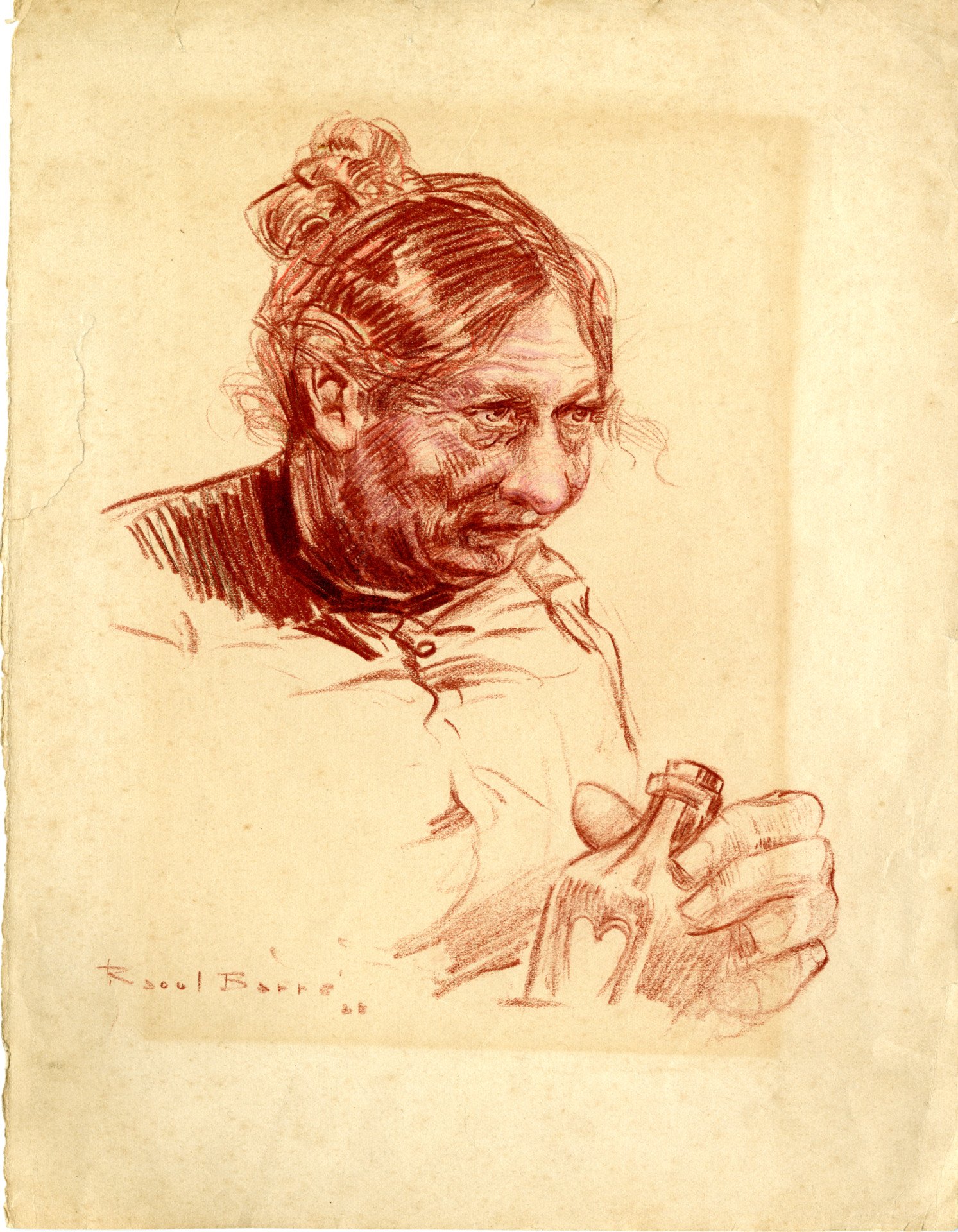
Drawing by Raoul Barré, 1928-1938, Coll. Cinémathèque québécoise : 2006.0474.AR.21
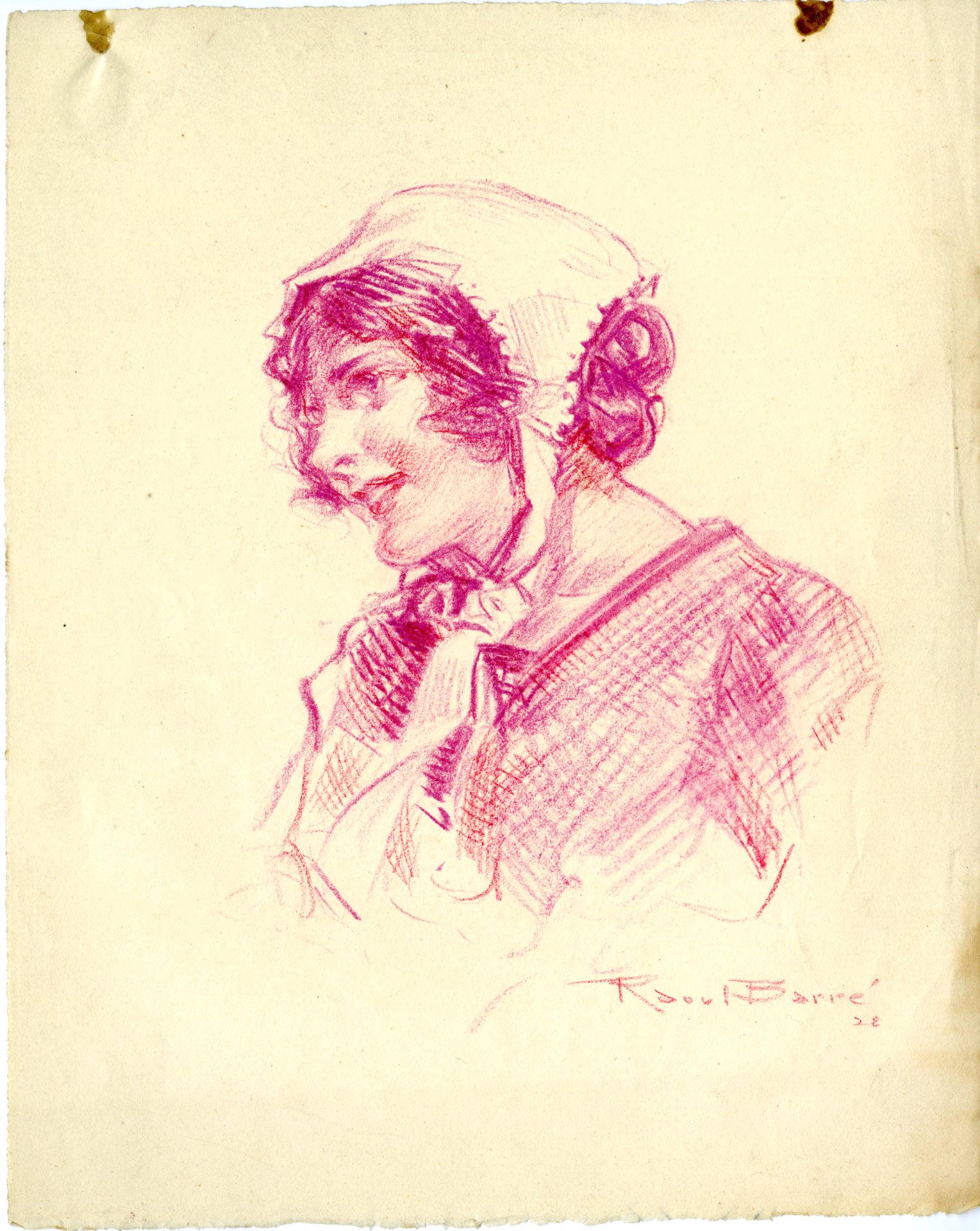
Drawing by Raoul Barré, 1928-1938. Coll. Cinémathèque québécoise : 2006.0474.AR.09
"Mr. Raoul Barré was born in Montreal on January 29, 1874. He began drawing at the age of 17 at Mont Saint-Louis.1 A few years later, he went to Paris to study his art.2 There, he drew for the Ollendorf3 publishing house and for the newspapers Le Sifflet,4 le Cri de Paris, and La Revue des deux Frances. His specialty is illustration.
Here in Montreal, he worked for major publishing houses such as Desbarats & Cie, McKim Bros, Montreal Litho. Co. etc. He also did some fine pages for Mr. Beaugrand's latest volume, La Chasse Galerie.
In Paris, Mr. Barré exhibited a drawing, l'Accapareur, which earned him praise from La Revue des Beaux-Arts et des Lettres, but his principal and favorite work is Le Bain, which was exhibited last year at the Galerie des Arts du Philippe (sic) Square.5
Mr. Barré returns to France in July for a two-year stay, in order to further improve his skills: and we have no doubt that he will do his homeland proud."
-"Les dessinateurs de ce numéro", Le Monde illustré, 30 juin 1900, p. 135. Our translation.
Following his initiation at Mont-Saint-Louis, Barré undoubtedly continued his artistic studies at the Conseil des Arts et Manufactures before moving to France in 1896. His first known work is an illustration published in Le Monde illustré in 1894, when he was 20 years old. Replacing Edmond Massicotte, who most regularly illustrates the cover of Le Monde illustré, Barré offers an illustration of “a night party in Boucherville”, held on the occasion of the 22nd convention of engineers-firefighters. His drawings were irregularly reproduced in this daily and in Le Passe-temps until February 1896. This periodical printed representations of scenes from the Théâtre-français, a troupe that had been presenting operas in Montreal since 1893.6
In Paris, Barré's career was supported by Achille Steens, director of La Revue des Deux Frances, which appeared from October 1897 to September 1899.7 The publication included a number of illustrations, and Barré's participation was first seen in the March 1898 issue, when he produced an original illustration for Steens' text L'Accapareur. He also lent his talent to texts by Madame J. Hudry-Menos (May 1898, p. 141, 148) and Rodophe Brunet (July 1898, p. 23), as well as drawing the banners for Chronique des Deux Frances, Échos de Paris and Chronique américaine.
Steens was also responsible for the Dreyfusard magazine Le Sifflet, published in 1898 and 1899, in which Barré published three drawings on March 3, 17 and 24, 1898. Le Cri de Paris appeared in January 1897, under the direction of the Natanson brothers, publishers of the famous Revue blanche, and Paul Dollfus.8 The magazine's bias was Dreyfusist and anti-colonialist, and Barré regularly associated himself with comparable political positions.9
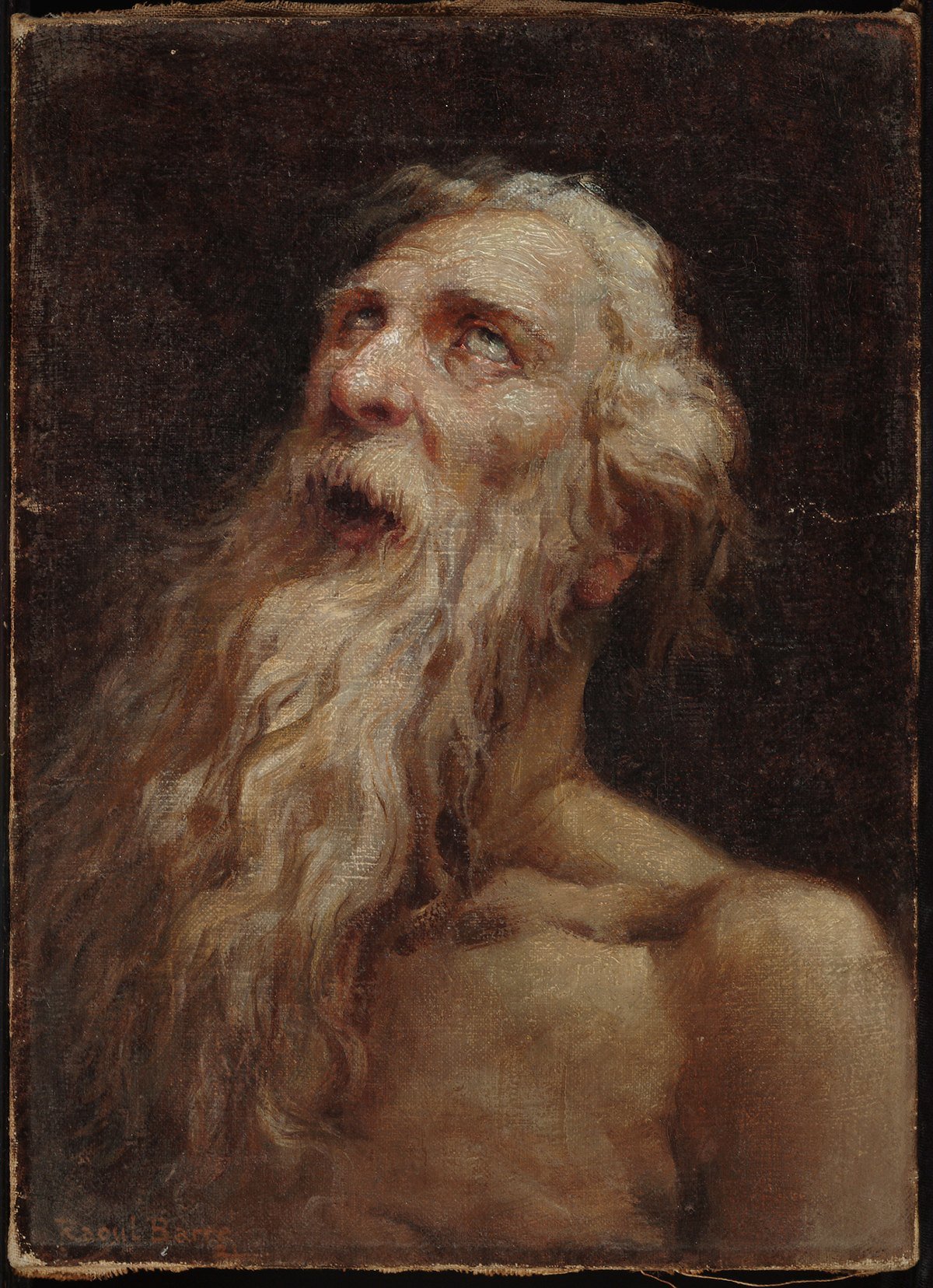
Portrait of Job. Raoul Barré. Montréal 1874 – Montréal 1932. Huile sur toile. 35,8 x 26 cm. Educational collection of the Montreal Museum of Fine Arts, donated by Marguerite Barré. Photo MBAM, Christine Guest. inv. Ed.1966.1
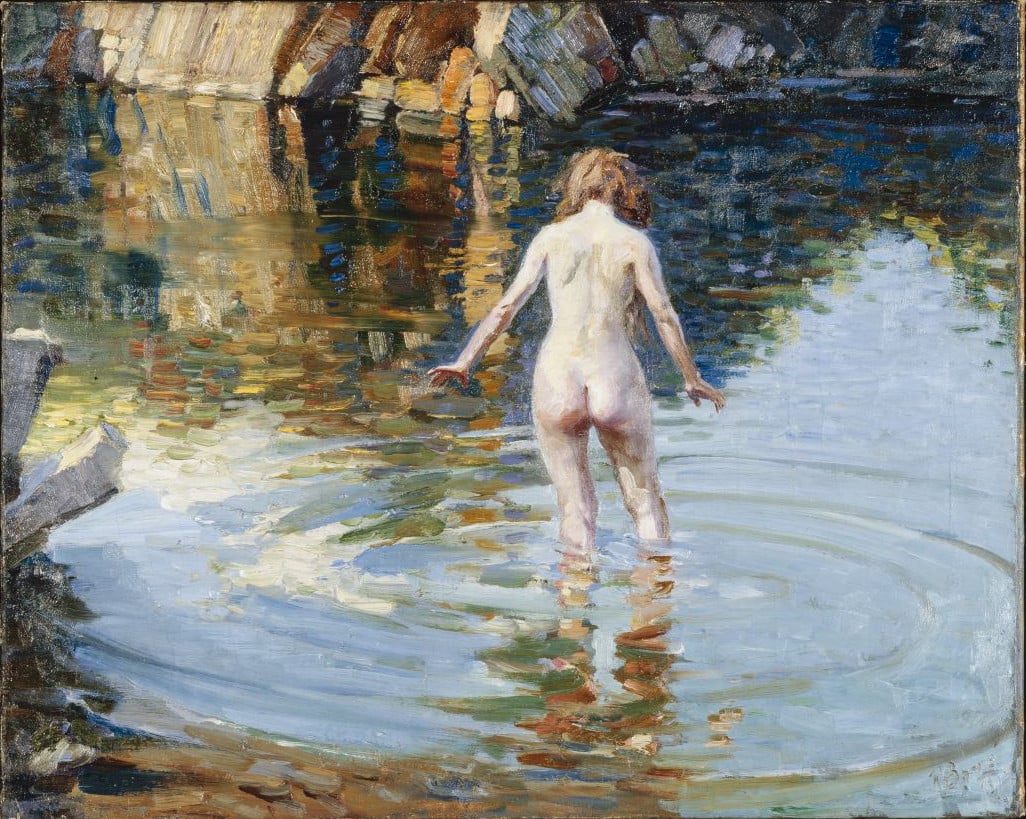
La Baigneuse. Raoul Barré, 1913. oil on canvas, 51 x 63,6 cm. Musée national des Beaux-arts du Québec – 1934.02
Gustave Comte confirmed in 1899: "He [Barré] has a very strong penchant for caricature, — that specialty in the art of drawing which we do not yet know and which we do not dare believe is as serious as it is, — and as a cartoonist, he is not a cartoonist who thinks, but a thinker who draws."10
On his return to Montreal in 1896, Barré continued his activities and became involved in many areas of cultural life. An enthusiast of the performing arts, he was active in amateur theater and took part in the Soirées de famille, which ran at the Monument-National from 1898 to 1901, under the direction of Elzéar Roy.11 He resumed contact with the journalistic world, which doesn't prevent him from commenting ironically on the place of journalism in French Canada in his cartoon in Les Débats of November 18, 1900. He also provided illustrations for Le Monde illustré. The full-page reproductions of his works reflect their quality and the interest of publishers in his art.
Gustave Comte describes his working environment as follows: "His studio! But it's a studio reduced to its simplest expression: a fairly large hangar, four walls and a glass roof. [...] he talked to us about Paris and art, the Salon and the French artists exhibited there."12
Raoul Barré's art is part of the post-impressionist movement. His landscapes, and La Baigneuse (Musée national des beaux-arts du Québec collection), show his interest in variations of light, light colors and generous use of paint. In this sense, he contributed to the dissemination of modern art values in the early 20th century.
The human figure dominates his work. His character and physiognomy studies - caricatures and portrait-charges - are characterized by schematic outlines enhanced by a few ink strokes. They demonstrate his talent as an observer and illustrator, while he works on the motif or with the aid of photography. His oil paintings, for their part, show an attachment to luminous tones applied with a spatula or broad brushstrokes.
Barré arranges his figures in shallow spaces and stages them in theatrical poses. In this way, the artist creates vivid genre scenes: representations of modern urban life or traditional rural customs. While these worlds may seem ideologically opposed, they nevertheless reveal the interests and scope of this attentive witness to his society, at different points in his career.
While his output as an illustrator and caricaturist is emerging, too few of his pictorial works are known, and much remains to be discovered about his activity as a painter, which would enable us to fully grasp and appreciate this aspect of his career.
Laurier Lacroix - UQAM
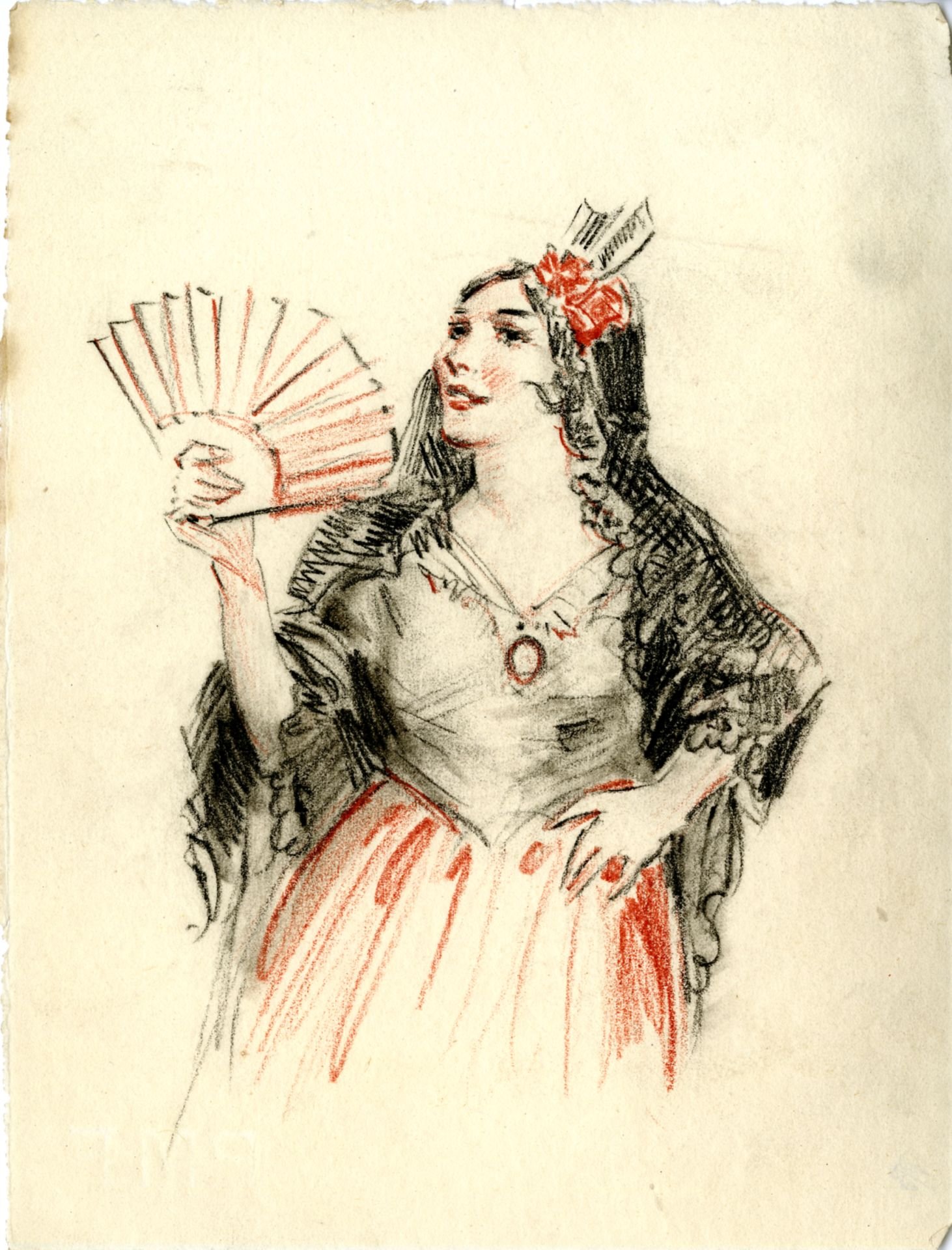
Drawing by Raoul Barré, 1928-1938. Coll. Cinémathèque québécoise : 2006.0474.AR.07
Footnotes
1 Joseph-Louis Barré, Raoul's father, is a wine merchant. The family lives at 50 avenue du Mont-Royal. Mont-Saint-Louis is run by the Brothers of the Christian Schools. A register of accounts (512075, community archives) shows that he was enrolled as early as 1889, taking piano lessons. From 1891, drawing lessons were the responsibility of Brother Martinus (1869-1923), author of two books : L'art ornemental: principes et histoire (1916) and La connaissance pratique du beau* (1924).
2 In the spring of 1896, Barré registered with the Secrétariat canadien de Paris (Paris-Canada, April 15, 1896), giving his address as 5, rue de Baune (sic). He became a member of the Société Canadienne de Paris (Paris-Canada, September 15, 1896), and attended a number of activities organized by French-Canadians living in France (e.g. Fêtes de la Saint-Jean-Baptiste). Samuel Montiège specifies that Barré was enrolled at the Académie Julian from 1896 to 1900, and that he lived at 14, rue de Beaume (sic) (see S. Montiège, "L'Académie Julian et ses élèves canadiens : Paris, 1880-1900", thesis, Université de Montréal, 2011, p. 243). In May 1898, he reported living at 41, rue Vavin (La Revue des Deux Frances, p. 174). There is no mention of Barré's presence in the student files of the École des Beaux-Arts in Paris. Barré introduces his self-portrait in the illustration "Une chambre d'étudiants à Paris" (Le Monde illustré, December 5, 1896, p. 502). By happy coincidence, Faucher de Saint-Maurice, on the same page, praises the novelty of the cinematograph that can be seen in Montreal. He provides a list of the Lumière brothers' films shown there. Rodolphe Brunet announces his departure from Paris at the end of July 1898 (La Revue des Deux Frances, July 1898, p. 59 and August 1898, p. 122-123).
3 Paul Ollendorf (1851-1920) was a prominent bookseller and publisher in Paris from the 1880s onwards. The Bibliothèque nationale de France's Gallica site does not allow us to identify the works Barré might have illustrated for this publisher.
4 Three cartoons signed by Barré are reproduced in the March 3, 17 and 24, 1898 issues of the Dreyfusard magazine Le Sifflet. Online : https://gallica.bnf.fr/accueil/fr/
5 The watercolor Le Bain was exhibited at the 20th annual exhibition of the Royal Canadian Academy held at the Art Association of Montreal in April 1899 (catalog no. 162).
6 These are scenes from Roméo et Juliette, La cigale et la fourmi, Guillaume Tell, Mignon (December 7, 1895, January 4, February 1st, February 15th, 1896). On the opera company, see: Mireille Barrière, L'Opéra français de Montréal, L'étonnante histoire d'un succès éphémère 1893-1896, Montreal, Fides, 2002.
7 The enigmatic figure of Steens is presented by Michel Pierssens, "Achile Steens et la Revue des deux Frances", in Passeurs d'histoire(s) Figures des relations France-Québec en histoire du livre, Québec, Presses de l'Université Laval, 2010, pp. 197-210.Rodolphe Brunet, the magazine's editorial secretary, adds: "Our compatriot, the illustrator Raoul Barré, has just completed the design for the Revue des Deux Frances, which will adorn its editors' cards.It's the symbolic head of France wearing a Phrygian cap, the feather planted in the headband that holds her hair, all on a sprig of maple leaves, the emblem of Canada. M. Barré executed this work with exquisite artistry, and the engraving was entrusted to Buffet" (La revue des Deux Frances, June 1898, p. 232. Online: http://eco.canadiana.ca).
8 Dollfus is, among others, the author of the illustrated work Modèles d'artistes, first published in 1888, which went through several printings at the end of the century.
9 For example, the cartoon "France et Russie", Le Monde illustré, November 21, 1896, p. 472 or "L'armement des Noirs", Les Débats, December 17th, 1899, p. 1.
10 Gustave Comte, "Silhouettes artistiques M. Raoul Barré", Le Passe-temps, February 18th, 1899, p. 1.
11 « Affable and possessed of a pure and chastened diction, he always found the singularly right and colorful word. [...] regulars of the Soirées de famille, at the Monument national, remember Désembois in Les Vivacités du capitaine Tic, and Machut in La Grammaire, and the other roles in which M. Barré showed the suppleness of his talent; they also remember his gift for monologue, for example the monologue au souffleur which we recently heard" (Gustave Comte, "Silhouettes artistiques M. Raoul Barré", Le Passe-temps, February 18th, 1899, p. 1).
12 Gustave Comte, "Silhouettes artistiques M. Raoul Barré", Le Passe-temps, February 18, 1899, p. 1. According to Lovell's Directory of Montreal Streets (1899-1900 p. 566), his studio is located at 486, rue Saint-Laurent and his residence is at 319, rue Rachel.